

The AI Affiliate Playbook: Five jobs AI can take off your plate
There's no shortage of people telling affiliate teams they should be using AI. The harder question is: using it for what?
Because knowing AI can make you more efficient is one thing. Knowing exactly how to use it when you need to build a business case, make sense of your reporting, prep for a publisher meeting or find your next growth partner is another.
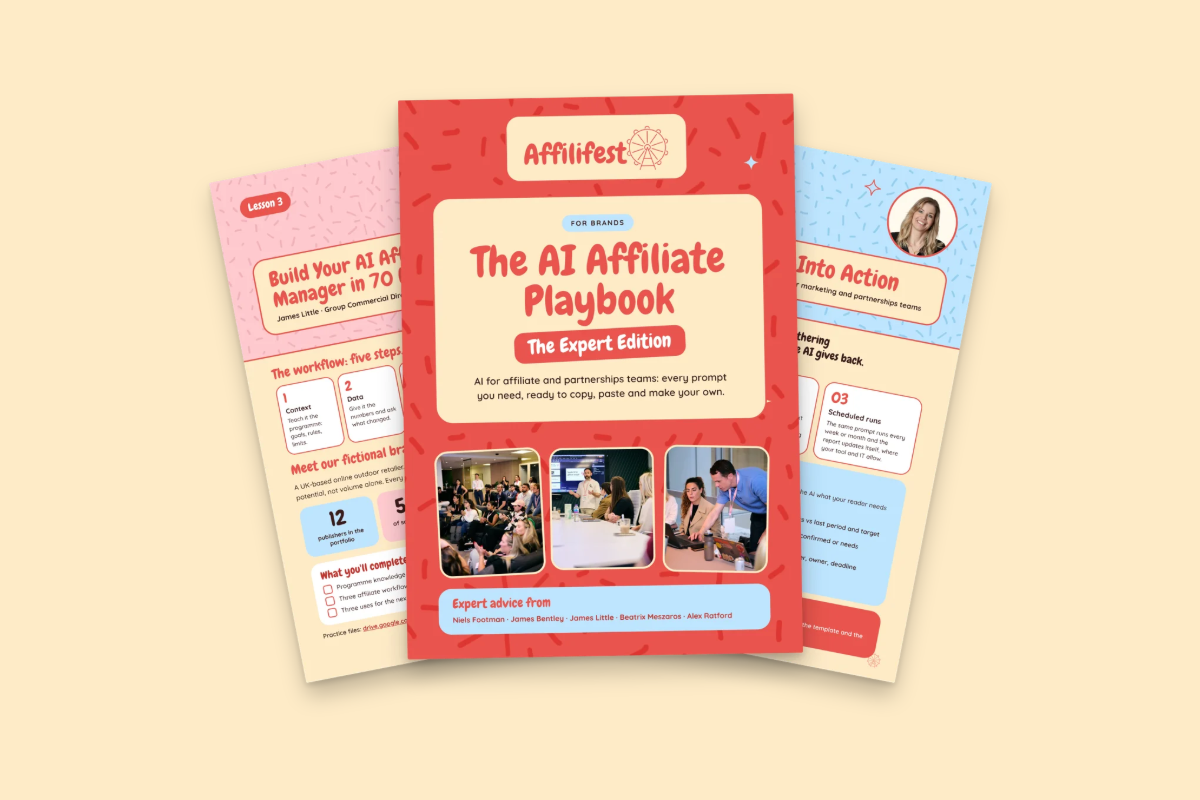
That's why we created The AI Affiliate Playbook: Expert Edition. 👉 Get your free copy here
Built specifically for brand-side affiliate and partnerships teams, it brings together practical methods from five experts, with prompts you can copy, paste, adapt and actually use in your role. Forget the “AI will transform affiliate marketing” predictions.
Here are five jobs AI can actually help with.
1. Build business cases that are harder to say no to
You know the idea is good. You know why the programme needs the investment. Now you need Finance to agree.
Niels Footman, AI trainer and consultant at Foot Forward AI, tackles one of the less glamorous but very real parts of running an affiliate programme: getting things signed off.
The playbook walks through how AI can interview you before writing anything, analyse the evidence both for and against your case, and then critique the finished argument from the perspective of the person most likely to challenge it.
That last step is the one most people skip.
Instead of asking AI to make your idea sound convincing, you can ask it to find the holes before somebody else does. Here's one of Niels's prompts from the playbook to try before your next business case:
“Before you write my business case, interview me. Ask the questions my [boss] would ask, one at a time, no more than five. Then tell me what's still missing.”
The result is a much more useful way of working with AI. Not “write my business case”, but help me build a better one.
And once you've got the process working, the playbook shows you how to turn it into a reusable setup for the next budget request, partner proposal or internal brief.
2. Get more from the data you already have
Affiliate teams have dashboards. Lots of them. The problem is that a dashboard doesn't always tell you what you actually need to know.
James Bentley, founder of Numerical, looks at what happens when AI moves beyond summarising numbers and starts helping teams interrogate them.
That could mean updating spreadsheets with the latest data, comparing performance against targets, bringing affiliate and customer information together or creating regular reports for colleagues. But importantly, it also means building verification into the process.
Because getting an answer quickly isn't particularly useful if you can't trust it.
The playbook introduces a demo workspace using synthetic data, giving affiliate managers a way to experiment without connecting company or customer information.
So if you've been wondering what agentic AI could actually look like inside an affiliate workflow, rather than just hearing people talk about it on LinkedIn, this is a good place to start.
3. Build your own AI affiliate manager in 70 minutes
This is probably the part a lot of affiliate managers will head to first. James Little, Group Commercial Director at TopCashback and co-founder of Affilifest, breaks the process down into five steps:
Context. Data. Diagnosis. Action. Output.
The first step matters most. Before expecting AI to give useful recommendations, you need to teach it how your programme works. What matters commercially? Who are your priority customers? Which publisher models matter? What are your approval limits? What can and can't be changed?
Once it understands that context, things get much more interesting.
You can use it to prepare for publisher meetings, review opportunities, create 90-day growth plans, turn messy meeting notes into clear actions or even role-play a difficult publisher conversation.
And the playbook gives you the prompts for all of it. The aim isn't to hand your programme over to AI. It's to build something that understands enough about your programme to make you quicker and sharper at running it.
👉 Get all five lessons in the free playbook
4. Stop reporting what happened. Start deciding what happens next.
Reporting can eat up a lot of time. Exports from different networks. Internal sales figures. Targets. Commission rates. Context from conversations that happened three weeks ago and somebody definitely forgot to write down.
Beatrix Meszaros, practical AI trainer and keynote speaker, tackles exactly that. Her section starts with a simple point: the analysis is rarely the slow part. Gathering scattered data, and then trusting what comes back, is. So instead of throwing data into an AI tool and asking it to “analyse this”, the playbook starts with the output.
What happened? Why? What needs attention? Where is the opportunity? Who needs to do what next?
That structure turns reporting from a backwards-looking exercise into something people can actually make decisions from.
There's also a reusable reporting prompt covering everything from combining network data to spotting unusual movements, reconciling figures, separating facts from hypotheses and ranking the actions that matter most.
And before anything gets sent? The AI audits its own work, while you still verify the important numbers yourself.
5. Find new partners without getting the same old list
Ask AI to find affiliate partners for your brand and you can probably guess what happens. The biggest coupon sites. Cashback. Big publishers. Maybe a few names you already work with. Useful? Not really.
Alex Ratford, Senior Publisher Development Strategist at impact.com, takes a completely different approach. Instead of starting with the brand, his method starts with the consumer.
It recreates the kinds of unbranded searches shoppers make while exploring and evaluating a purchase, then uses those searches to uncover specialist blogs, independent reviewers, comparison sites and other potential partners that might otherwise be missed.
Then comes the part most tools skip: ranking them. Rather than relying on an AI-generated paragraph about why a publisher “could be a great fit”, candidates are scored against relevance, scale and commercial fit using a consistent Expected Value calculation.
So partner discovery becomes less:
“Here are 20 websites you might want to look at.”
And more:
“Here are the partners worth looking at first, here's why, and here's the working behind it.”
The bigger point: AI should make the work better, not just faster
There's a theme running through all five sections of the playbook. AI works better when you stop treating it like a magic answer machine.
Give it context. Give it rules. Make it show its working. Ask it what it might be getting wrong. Separate facts from assumptions. And keep an actual human responsible for the final decision.
The playbook deliberately builds those checks in throughout. No personal customer data. No confidential rates or unreleased figures. Calculations should be verified. Commercial decisions and partner communications still have a human owner.
Because the opportunity here isn't replacing the affiliate manager. It's giving the affiliate manager a much better set of tools.
The playbook is already in use at brands like Samsung, Tripadvisor, Strava, Gymshark, Merlin Entertainments, Trip.com, Proton, Hostinger, Vyrao, Ocean Bottle and Liberty London.
So, where do you start?
You don't need to rebuild your entire workflow tomorrow. Pick the bit of your job that currently takes too long.
The monthly report you dread doing. The publisher meeting that takes an hour to prep for. The business case sitting half-written in a Google Doc. The partner discovery exercise you keep pushing down the list.
Start there.
The AI Affiliate Playbook: Expert Edition gives you the prompts, practice exercises and frameworks to try it for yourself.
And crucially, it's designed to be used, not just read.